11 May 2010

OUR THIRD AGE: Scene 2

FIRE AND ICE

‘To treat life as less than a miracle is to give up on it.’
Wendell Berry

By around 30 million years ago the new layout of continents and a change in Earth’s tilt were beginning to create the distinct ocean currents and climatic zones of today. The following set of six zones is a lay-summary of the zones used by geographers.

Tropical climates are either hot and wet all year round, or hot all year but with monsoonal rainfall that divides each year into a distinct dry and wet season. Humid middle-latitude climates have dry summers (either warm or hot) and wet winters (either cool or cold). ‘Continental' climates have a lower rainfall and a huge seasonal temperature range. Arid and semi-arid climates have very little rain and a huge daily temperature range. Cold dry climates have enduring ice, tundra and/or conifer forests, and a very short summer. Polar and alpine climates are bitterly cold all year round, and any rain falls as snow.

Biologists call these climates and the organisms within them biomes, or ‘zones of life’.

In huge Equatorial rainforests, with the Sun virtually overhead every day and rain falling all year round, there is a huge variety of easy food for all kinds of organisms. And at this stage it was a relatively safe habitat for the diversifying primates. Most still ate young juicy shoots but some were becoming skilful at finding insects, fruit, and large tasty seeds, full of proteins and vitamins, otherwise known as nuts. As these were full of proteins and vitamins, they didn’t need to spend so much time eating. That left more time for play - relaxing, experimenting and socializing.

Among these primates were early fast-thinking and moving monkeys; and an ancestor of apes, Dryopithecus. They were developing better hand-eye co-ordination, specialist colour vision to help them pick out ripe fruit, a good memory, and flexible communication and problem-solving skills.

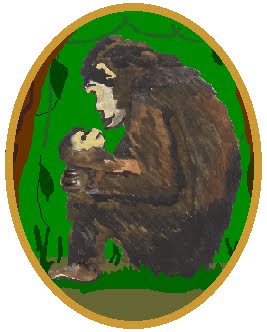
All this meant proportionally bigger brains and bigger skulls to protect them, and these brains had an outer layer with more folds and nerve connections than before (a neo-cortex). But since a birth canal could widen only so far their infants were born with immature brains that kept developing after birth. This meant that mothers had to move around the trees with a very dependent, bulky baby attached.

Meanwhile away from the Equator in humid areas such as the eastern coasts of continents trees were becoming less densely grouped, as rainforests gave way to dry forests and woodlands. As the tree-cover declined, the giant browsers would be replaced by mammoths and mastodons - no longer gigantic, but still bigger than the largest land-mammals today.

And the ancestors of modern carnivores would join, and eventually replace, the sabre-tooths. In Eurasia and Africa more agile cats started to appear. They had shorter incisors that could puncture a jugular vein and molars to slice and grind flesh. And in North America there were very efficient wolves and other wild dogs, and also large dog-like carnivores, like bears. 

They were all still solitary hunters, and they preyed on the smaller browsers, like early deer. And they were developing more flexible bodies and brains that helped them crouch in ambush, stalk, chase, pounce, and then hold their prey as it tried to dislodge them. With front-facing eyes (but no need for colour vision) they could select a victim from a distance and keep focused on it as they edged their way into striking range - keeping downwind.

In their playing young carnivores had to develop these complex survival skills. But their rich meat diet meant that they had plenty of time for playful learning. A successful carnivore mother had to be a good teacher, gradually letting her offspring take more responsibility in a kill. Those who did not learn how to do this step by step went hungry. Each mother had to expect a high death rate in her litters.

As we have seen, coevolution is not a sentimental process, and the dynamic balance among plants, plant-eaters and carnivores in any ecosystem is based on fewer plant-eaters than plants, and fewer carnivores than plant-eaters.

Grasslands were also starting to form on most continents, usually inland or along the western coasts, in what climatologists call ‘continental’ climates. Grasslands in tropical and sub-tropical areas are called savannas, vast plains of simple low-growing plants that could cope with dry periods, and did not have exposed growing cells at their tips. So they could survive being eaten by the grass-eating mammals that were coevolving with them - as long as the grazers kept moving.

They were more subject to wildfires than rainforests, and this became a factor in their evolution. Many of their seeds survived such a fire, and with their short life-cycle, the savannas quickly recovered – as long as there was rain soon. On the slopes and plains of the Middle East and South Asia, the grasses included the ancestors of wheat, barley, millet and rice. Their annual life-cycle and rich plentiful seeds would be the foundation of early agriculture.

The Northern Hemisphere mammals that came from the woodlands out onto the savannas would evolve into a range of deer and gazelles. They were developing high-crowned teeth to protect themselves from the harsh protective silica in the grasses, which were also pretty poor food. To cope better with this and with drought, they developed complex stomachs to re-digest the grass. They needed these more than they needed complex brains.

But they had to spend most of the day eating and digesting, and they were very visible as they grazed on the wide plains. They became very good at picking up the presence of a carnivore by noticing the left/right symmetrical pattern that indicated an animal in the grass. And they also evolved into quite speedy runners.

So did the various predatory cats and dogs that were evolving. Among them were the ancestors of hyenas, who from this time until today have had the crucial job of finishing up the remains of another hunter’s kill – scavenging. They have to be able to pick up the scent of death, wait until any more dangerous carnivores are finished, and then strip the carcass as quickly as possible. And their brains have developed accordingly.

Drier areas were also increasing across Earth now: arid deserts, semiarid steppes, conifer forests and tundra.

In the vast deserts that were forming in Africa, Australia and the Americas reptiles were the most common vertebrates, burrowing underground to escape the extremes of the noonday heat and the nighttime cold. (In the deserts of today’s Central Australia is a unique little reptile, the Thorny Devil. They drink through their feet, collecting water from wet ground in the crevices between their scales. And then drops of water move through these crevices up to their mouth.)

Because monsoonal rains sweeping north from the Equator hit the ever-rising walls of the Himalayas and remained in today’s India and Bangladesh, vast cold steppes were now developing in Central Asia. They had hardy plants that provided food for hardy grazers like camels and little stocky horses, and they will play a very important part later in our story. Further north, in a forested band around Earth, hardy conifers provided a habitat for a few equally hardy cone-eaters and their predators, like ancestral squirrels and pine martins.

In a broad belt around the rim of the Arctic Circle, and on the Tibetan plateau, the tundra was evolving, with sparse and even hardier flowering grasses in summer and little except lichens in winter. Yaks and reindeer rely on them, having to cover huge distances to find enough. Alpine areas are even harsher – with a growing season of only 180 days, and bitterly cold winters. And then there were Low Arctic areas – with similarly cold winters but a growing season of only 50 days.

But the most severe climatic zone was at Earth’s Poles. The Sun had always been too low in the sky, even in midsummer’s six months of sunlight, to provide plants with a real growing season, and a Polar winter has six months without the sun. From now until today (except for occasional greenhouse eras) they have also had year-round ice. In response specially adapted mosses have emerged in the Antarctic continent and on the permanent ice-floes of the Arctic Ocean. And very few animals are able to live anywhere near the Poles.

The coastlines off today’s frozen Arctic Ocean have specially adapted flowering annuals, and over millions of years some bears and foxes would slowly make the necessary adaptations as they ventured further and further north, until polar bears and then Arctic foxes evolved. But at this point in our story they had not yet evolved.

Two former land-mammals would survive in the oceans by migrating to warmer climates during their breeding season - whales and seals. Of these whales are amazing not only because of their size and constant migrations. Like primates they are big-brained mammals and give birth to very dependent offspring, but because they evolved in an ocean environment their brain development differed in many ways. We are only now beginning to understand just how complex the differences are.

In and around the deeply frozen, dry and gale-swept continent of Antarctica virtually all birds survive winter today by adopting a way of group living that includes migrating together to warmer areas, where they breed and raise their infants. Of course these birds include penguins, whose other main adaptation was becoming swimmers rather than flyers.

Two of today’s iconic examples of bird adaptation in order to make it through Polar winters had both emerged by this time.

Intrepid Arctic Terns breed in the Arctic summer, fly south for the Antarctic summer, and then return north. In the course of a year they fly 60,000 kilometres, with very few dying. Like other migrating birds they use a variety of directional aids. At night they fly by the stars; by day they respond to sound waves from the landscape; and at all times of the day or night their internal compasses orient them to Earth’s magnetic fields. Perhaps most importantly they rotate times of leading the flock and times of resting in the slipstream.

Meanwhile Emperor Penguin fathers – stoic rather than intrepid – carry on through deepest winter on the barren Antarctic continent. They spend the twilight of early winter building up good fat reserves, and then fast for the two months of utter darkness, huddling together, and changing places so that they all have some time away from the freezing winds. Again and again they shuffle between places exposed to the freezing winds and more sheltered spots. Between his breast feathers and his feet each one is keeping an egg warm, and later a chick. Again the survival rate of infants to this stage is quite high.
Their partners are hunting in the fertile environment of Antarctic seas. Relatively comfortable under the thick ice-cover, they are building up their fat reserves, and pre-digesting food for their chicks. When the twilight of late winter returns they relieve the fathers, feed the hungry chicks and then prepare them for life in the sea.

Our mammalian ancestors were by now also experimenting with survival strategies based on group living, as we shall see in the next scene.

* * * * * * *

AUSTRALIA’S SEPARATE EVOLUTION

‘South of my day’s circle
I know it dark against the stars, the high lean country
full of old stories that still go walking in my sleep.’
Judith Wright

As Australia’s tectonic plate collided with the Indian and Pacific Ocean plates violent volcanic activity began to push up the islands that form today’s Indonesian archipelago, and the long mountain range in Papua New Guinea. Over the next 25 million years there would also be volcanic activity along the eastern part of Australia, creating Mount Warning, the Warrumbungles, Mount Canobolas and Lord Howe Island.

Indonesia and Papua New Guinea cut off much of the monsoonal rain sweeping south from the Equator, but Australia was now near the Equator. So the steppes and deserts that evolved here, unlike those in northern Asia, would be very hot during the day and nowhere near as cold at night.

Trees would virtually disappear from central areas. And near the eastern coast rainforests, including the one at today’s fossil-rich area of Riversleigh, would be reduced to pockets. Elsewhere were dry forests that would be abundant until a few million years ago. They contained several trees that are today unique to Australia: conifers such as the Huon and Wollemi Pines; the huge range of acacias (wattles) that like African acacias (carobs) evolved from a common Gondwanan ancestor; and eucalypts, which also evolved in Gondwana but would soon survive only here.

In its isolation our continent was developing its own distinctive life zones. Today more than 80% of its plants and animals are unique. Along low-lying tropical and middle-latitude coastlines there are tidal mangroves or sand dunes, and on southeastern coasts with adjacent ranges and foothills there are dry forests. Inland and on the west coast there are intermittent rivers and lakes, semi-arid scrubland, tussock grasslands, salt marshes, gibber plains and deserts.

All vegetated areas are susceptible to wildfires, and so plants have a variety of fire-survival strategies. Thus eucalypts produce short-term epicormic growth to hasten photosynthesis after a fire, and banksias’ seedpods need a fire in order to split open.

At this stage in the dry forests were spiders that lived in the trees, diverging from the others as they tried out new ways to catch their prey among the branches: moths, flies and beetles. Some call them apprentice-weavers because they were the first ones to make silk-woven snares to catch prey. They also trailed silken safety lines wherever they travelled.

Among them was the Red-back Spider, which, like Sydney Funnel-webs, have adapted to live in built-up areas, and are often found close to our houses. But only the elegant females are dangerous as they protect their young with a venom that can kill humans, and are often picked up by accident. As well as their insect prey, females’ sticky tangled webs usually contain a number of diminutive suitors, several egg-sacs, or hundreds of spiderlings - depending on the season. When they are old enough the spiderlings disperse into the air in tiny silken balloons.

At the other end of the scale again, in demonstration of their fitness for Australia’s harsh environment, reptiles, flightless birds and marsupials were all multiplying and diversifying. And some were growing very much larger, particularly in the scrubland. One marsupial of these times is the diprotodont. They were like giant wombats, the largest of their species being the size of today’s rhinoceros.

But there were many other kinds of marsupials, adapted to the various ecosystems. In its isolation Australia was an excellent continent for convergent evolution to apply, with similar animals filling the same ecological niches in different places.

Soon there would be native-cats – in the same niche as ocelots in South America; grazing kangaroos – instead of Africa’s antelopes; and sugar-gliders – like the Northern Hemisphere’s flying squirrels. And there would be marsupial moles and wolves, and several agile tree-dwelling and cliff-dwelling marsupials, and of course the fiercely competitive, but also endangered, marsupial carnivore, the Tasmanian Devil. Even monotremes have their niche here – like echidnas, which are the equivalent of placental ant-eaters elsewhere.

But Australia’s most amazing mammal is another monotreme, today’s reclusive Duckbilled Platypus, with no equivalent on any other continent. And it appeared about this time. The females laid their eggs in a burrow on a creek-bank, and they spent most of their time in the water. By now, instead of teeth like their ancestors, they had a bill that looked a bit like that of a duck. But this was a special kind of bill. Among other things, it could sense the presence of their prey animals, as they swam along the bottom of the creek.

* * * * * * *

OUR THIRD AGE: Scene 1

--> -->
LEARNING THROUGH PLAY
‘Animal play is experimenting in a relaxed field.’ 
Robert Fagen

Around 60 million years ago  (or Once upon a time . . .) life was beginning to recover from Earth’s Fifth Major Mass Extinction. With no more seemingly insatiable browsers, flowering shrubs and trees were forming thriving and diversifying forests on each continent. And all the recycled dinosaur bodies in the soil were also a great help.

Many plant and animal remains had also found their way into huge depressions on continental shelves and ocean floors. Some would be compressed into new carbon deposits, and then some of that would be trapped below impenetrable rock by violent movements in Earth’s crust. Over millions of years this would become natural gas and petroleum, literally ‘stone oil’, the most significant and aptly named fossil-fuel today. Based on the contribution of dinosaur remains to the mix a few environmentalists call it ‘dinosaur-blood’ to remind themselves and us of its age and unrenewability.

Meanwhile most mammal species were small and competing fiercely for space. Many were losing the struggle and becoming extinct but the successful ones were diversifying to fill the ecological niches left by various dinosaur species. The males were still solitary, and the females lived with their young only until they could look after themselves. And all still had a distinct smell of their own, and a strong sense of the smell of other mammals.

Offspring stayed close to their mothers, practising through play the skills needed for browsing, mating, escaping and/or fighting. Those that didn’t learn were more likely to die without reproducing. So mammals were establishing an extremely significant way of living as far as human evolution is concerned: the development of life-skills through play. Simply put, their programming included an urge for playful learning, and a part of the mammalian brain called the hippocampus was developing, able to store memories of what they learnt.


But a few were beginning to grow larger in the diversifying forests. The first ones to do so were browsers, with one eye on each side of their head to keep watch for danger as they ate – they needed a lot of food. Some of them had developed long trim legs designed for escape from predators: the forerunners of horses, giraffes, camels and buffalo. And some had developed shorter thick legs designed for standing and fighting them: the forerunners of elephants and rhinoceros.

Their predators included creodonts, the fore-runners of today’s carnivorous mammals, although they were still small, and hadn’t yet diverged into distinct dog and cat families. But the most dangerous might have been huge flightless birds, like Diatryma, in North America. They were 2 metres tall, with strong kicking legs, a skull almost as big as a modern horse, and a hooked beak that capable of killing their prey with one snap.. They apparently preyed on small browsers like Hyracotherium, an ancestor of horses.

In the trees were ancestral primates, eating young treetop leaves and shoots, as well as seeds and fruit when they could find them. They were early members of the order of primates, diverging from other mammals because of their different life-style.


They had long free-moving limbs and grasping feet, more like hands, but at this stage they were slow-moving and slow-thinking., However the offspring had to observe and practise complex new skills relating to their treetop life-style. These included finding and reaching for food high in the trees, and avoiding their predators on the ground by moving from branch to branch. Their learning must have involved a lot of risky trial and error, challenging the hippocampus to remember more and more.

Since well-focused eyesight was more useful in the trees than a keen sense of smell was, over generations their sense of smell would diminish and their sight improve. And, like carnivores, they were developing eyes that faced to the front. One early primate was the Adapis, 40 cm long.

Eventually huge plant-eaters were browsing on high-growing leaves much as giant dinosaur plant-eaters had done. In Asia they included Indricotherium, a hornless relative of today’s rhinoceros, and the largest land-mammal ever. But it weighed only up to 20 tons, and stood only 6 metres high at the shoulder.

By now larger mammal carnivores had evolved, including sabre-tooth cats. They needed food less often than their prey did, but, although there was plenty of it around, a large mammal took some catching.

It seems that each cat had to stay undercover to ambush a large browser, creep almost underneath it as it fed, inflict a fatal ripping wound to its huge belly or throat with its sabre-like incisor teeth, get out from under, and then wait until it fell down before feeding on it. But it did not need to make another kill for some time.

Around this time bats emerged, and the Pakicetus mammals returned to the water. They were the size of otters but their descendants include the Blue Whale. With females up to 30 metres long and 150 tonnes in weight, they are larger than any dinosaur yet discovered.

(At the other end of the scale another long-living descendant of primitive spiders evolved in Australian rainforests, living in much the same way as the older, more timid Trapdoor Spiders. We call them Funnel-web Spiders, although the webs in their burrows, where they huddle during the day, are more like long socks.

(Several spiders are known to be among the most dangerous creatures on Earth today, and the notorious Sydney Funnel-web Spider, Atrax robustus, is one of them. They are very unusual among spiders because it is the male that causes human deaths. During summer and early autumn, on the New South Wales central coast and mountains, they leave their burrows to go courting. They are so pumped up that they attack in response to any perceived threat, regardless of its size. And so humans do not intimidate them. When on a death-defying mating expedition one of their males can kill a human who gets in his way.

Their cousins, the Blue Mountains Funnel-webs, are not so dangerous to humans because they do not live in built-up areas.

Around this time perching songbirds, or passerines, emerged in Australia, and from there began to radiate out across the Earth. The Australian lyre-bird is their closest relative today.

Meanwhile, as the Atlantic Ocean expanded between Eurasia’s west coast and the Americas, the rim of the Pacific Ocean was disappearing under Eurasia’s east coast (forming the volcanic islands of Japan) and under South America (forming the Andes). India and Eurasia were also being pressed together, progressively pushing up the soaring triple range of the Himalayas (although the vast Tibetan plateau that has such an enormous effect on Earth’s climate may have already been raised in previous tectonic movement). And Africa was coming ever closer to Eurasia.

As Africa’s and Eurasia’s continental shelves were thrust together huge petroleum deposits were trapped beneath areas that were beginning to dry out, and the European Alps and several Middle Eastern mountain ranges began to rise. Once today’s Morocco came up against southern Spain the deepest part of the enclosed Mediterranean Basin would be in turn sea and saltpan as the Atlantic Ocean rose and fell with Earth’s temperatures. Then 5 million years ago a surge of Atlantic water gouged out the Strait of Gibraltar 300 metres deep, and since that time this deepest area has been the Mediterranean Sea.

Today the Pacific Ocean’s submergence under Japan and the Americas still causes upheaval, and so do India and Africa as they keep moving north against Eurasia. In the future today’s Alps will be a much higher barrier than they are today.

(In this period Australia finally split away from Antarctica and moved north, with New Guinea still attached. But the islands of New Zealand were now being pushed up, and the Tasman Sea was forming between Australia and New Zealand. As it became isolated New Zealand retained no mammals of any kind. Without them a reptile and three flightless birds would thrive for millions of years: the tuatara, and the moa, kakapo and kiwi.

(Australia had monotremes, marsupials and placentals at this stage. So why are there no placentals here today, apart from bats that flew in later?

(The monotreme ancestors of the echidna and the platypus could only survive by filling an ecological niche that had no marsupial or placental competitors. But a marsupial mother would have an advantage over a placental mother in the hard times that became the norm in inland Australia. She could keep an embryo dormant in her womb, or allow a foetus in the pouch to die as her special foetal milk dried up. By contrast a mother that fed her infant through a placenta was likely to die with it.

(So marsupials prevailed because they were fitter for their Australian environment.)

Marsupials in South America weren’t so lucky. As their homeland moved north, volcanic eruptions would lift Central America out of the ocean, and before long the vast majority would be displaced by placentals that had crossed this new bridge. Among those to die out first would be the carnivores, like the marsupial sabre-tooth, Thylacosmilus. Those that remain today, like the opossum family, have survived so far by staying small, maintaining a nocturnal life-style - and eating with what some unkindly call a vacuum-cleaner approach.

But back in our story, a severe climate change was beginning. For billions of years Earth’s inclination to the Sun had varied as a result of its landmasses moving, joining and separating. This was because the Moon’s gravity pulled most strongly on the parts of Earth covered by an ocean. Now that a seaway (what we call the Antarctic Ocean) had opened up around Antarctica, there would be a change in the circulation of water and winds around every continent, and also a slight change in our planet’s tilt.

Over the next few million years a cold circumpolar current built up, leading to a huge deepening blanket of ice on the new continent and the extinction of plants and animals there. And then a very cold period followed across Earth for 10 million years. 

* * * * * * *

OUR THIRD AGE: Title Page & Song


MALES AND FEMALES


‘I have given suck, and know
How tender ‘tis to love the babe that milks me.’ 
Macbeth, I, vii, 54-5


‘A society that does not keep its young men occupied
will pay a high price.’ 
Margaret Mead


This time the song is a very short children’s round. I think it captures the idea of coming to terms with what happens to people’s bodies after they die - as early humans were beginning to do.

Obviously they wouldn’t have had a song like this - using verbal language, imagination, mock fear and humour. And the adults would have been still trying to overcome their own fear, not yet ready to make it into a game for their children.


 Have you seen the ghost of Tom?
Long white bones with the flesh all gone.
O - o - o - o - o - o - o - h,
Wouldn’t it be chilly with no skin on?


29 July 2007

OUR SECOND AGE: Scene 5


THE BIRDS AND THE BEES

‘We see things not as they are but as we are.’
The Talmud

Around 70 million years ago (25 million years before birds with artistic specializations emerged) plants were creating a very refined form of sexual display, which would take interdependence between diverse creatures in a radically new direction.

It had started millions of years before when some low-growing plants evolved into angiosperms by producing flowers instead of cones and protecting their seeds in an ovary.

When the flowers opened, some of the sticky male cells (pollen) drifted onto a female organ nearby, and so set their reproductive process in motion. Fertilization could take place in the same flower, in another flower on the same plant, or on a flower of another plant. As usual, reproduction involving two plants increased a species’ genetic diversity, and with the wind’s help their pollen spread far and wide.

But now early water lilies and low-growing magnolias were displaying larger, coloured or fragrant flowers, and magnolias were growing taller too. They were vying for the attention of a range of insects and birds that noticed and responded to various hues and scents.

From an evolutionary point of view, it seems clear that the sensitivity of different pollinators to a different range of colours within the floral smorgasbord seems to be another example of conflict avoidance. Plants and animals both benefit from operating within a niche market.

As the insects and birds harvested sweet nectar from flowers shaped to suit them, they collected pollen on their bodies. When they visited other flowers of that species, pollen rubbed off on a female sex organ in enough cases to increase the reproduction rate above that from wind pollination.

Like other plants angiosperms still set more seeds than necessary, and some birds and animals still ate the excess.

Soon some plants were giving their seeds a protective coating so that they could lie dormant for longer, while others started growing nutrient-rich fruit around their seeds to provide ready-made fertilizer for the seed when it dropped and decayed. Some fruit became juicy and sweet when ripe, and even brightly coloured. And so its scent or hue attracted other birds and animals, which either discarded the seeds after eating the fruit or swallowed and excreted them somewhere else.

Meanwhile a few plants began to protect their seeds or leaves with toxins to discourage food-seekers, and a few animals were in turn developing a liver that filtered out the toxins. Today some fungi use not only poison to discourage potential consumers, but also bright colours like red – ignored at the forager’s peril.

All this interaction is based on protecting and passing on diverse ways of being alive, and communication within the system is an integral part of that.

(One example of Australian flower and animal coevolution is the nectar-flow of banksias and grevilleas in certain areas. It coincides with the breeding season of local honey-eating birds, with their specialised brush-tipped tongues. And it also triggers the breeding season of their predators: kookaburras, goannas and snakes.

(Honey-eating and fruit-eating mammals that feed at night, like possums and bats, are also part of these ecosystems. As today’s bush-regenerators in the Blue Mountains know only too well, in disturbed ecosystems some exotic plants also successfully co-opt native animals, particularly birds, in generating and spreading their offspring.)

The mechanism of an animal’s colour vision is an integral part of its way of living. Flower, fruit and insect harvesters need tg be able to distinguish colours, often including those in the ultra-violet part of the spectrum, while animals that feed on grass or meat have little or no such need.

The physics and chemistry involved in the actual production of colour, however, is much more complex.

As it is in Earth’s rocks and minerals, it seems to be basically a matter of a range of pigments, a process that started as we have seen with the green photosynthesizing pigment chlorophyll. But in birds like peacocks and flying insects like butterflies it is often a process of developing a series of reflective surfaces that scatter light into a range of colours.

Theories based on either random or creative evolution cannot yet explain how this emerged, or how the wonderful complexity of colour and light used by a range of animals in communication emerged. (A not-so-well-known example is seen in today’s cuttle-fish gathering to spawn off Australia’s south coast.)

Back in our story several flying insect families engaged in co-evolution with flower-bearing plants were by now undergoing a more drastic kind of metamorphosis - from a soft larval form through pupation into a very different adult form.

Their transformation within the pupa is very mysterious. The cells making up the larva break down into a genetic soup, from which adult cells gradually emerge, divide, multiply and differentiate.

A few biologists think that this is a remnant echo at the cellular level of an ancient battle, in which an early flying insect took over the body of a soft-bodied crawling insect. If this remarkable theory is true, it is yet another example of competition being transformed into joint effort.

Some of these insects were also creating distinctive social groups. Like dinosaurs and mammals they limited the number of offspring, and then spent a lot of time and energy looking after them - but they had an idiosyncratic way of doing it.

Their strategy was to clump lots of infertile females around a very fertile ‘queen-mother’, with a few males being specially produced just before her single mating-time.

The colony‘s members built a communal home around her eggs and helpless larvae and then formed separate nursery and defence cohorts, using chemical signals to communicate with each other in an instant. Most scientists describe such groups as operating like a complex organism because they work in such close co-ordination - like cells in a single being.

As anyone who has kept bee-hives knows, warrior bees in a hive that has lost its queen fight in wave after wave of suicide squads. And ant warriors are particularly aggressive in the first years of a colony, when they have many young to feed and only a few adults foraging for food.

Of course most metamorphosing insects did not develop societies. Today, like virtually all spiders, and like monotremes, they live alone but for a brief and dramatic mating. Some, like moths and butterflies, lay their eggs on a beautiful tasty leaf, from which the larvae crawl onto other leaves, eating and growing until their biological clock tells them to pupate. And some, like wasps, carefully prepare a burrow and lay their eggs inside in or on a ready-to-eat meal – either still alive or specially killed.

(Many Australian native bee species are also solitary – and stingless. We are only beginning to appreciate their uniqueness and diversity. Our iconic social insects are termites - either inspiring home-builders or devastating home-wreckers, depending on your point of view. They have also made themselves useful to people in northern Australia over thousands of years by hollowing out tree branches, which men then use to make a unique musical instrument – the didjeridoo.)

Today we see social bees, wasps and ants as the embodiment of vigorous protection of one’s territory against outsiders. Whether it emerged among them or not, territorial protection is an essential part of coevolution, limiting local population growth and thus reducing potential competition for resources, and also enabling the development of self-protection skills.

Most animal species today see protection of territory from outsiders and local competitors as a top priority whether they live in groups or have a solitary lifestyle. Plants are also territorial to different degrees. (In the Upper Blue Mountains the most notorious examples are noxious weeds like blackberries and montbretias.)

As we have seen with colour vision, the members of each species within an ecosystem perceive only a fraction of the total reality of their territory. They take in only what they need to know in order to have a chance of surviving and thriving. Since their most urgent needs relate to food and water, reproduction, and avoiding or escaping danger, they generally see the world through this frame of reference (whether instinctive or learned).

At this point in our story a flowering plant’s frame of reference for an insect was its hairy legs and wings (pollen-courier). A plant-eating dinosaur’s frame of reference for a tree was its tasty leaves (browser food). A dung beetle’s frame of reference for a dinosaur was its tasty warm dung (dung beetle food) and big feet (danger).

The point is that such frames of reference are absolutely functional - as long as there is no sudden change that threatens a whole eco-system’s survival.

But around 65 million years ago Earth’s Fifth Major Mass Extinction occurred. Tectonic movement had separated Africa and South America, pushed India north, almost split Australia and Antarctica and moved Africa’s northeastern corner closer to Eurasia. Now the Atlantic Ocean was widening, with the usual violent disturbances.

(New Zealand had also begun breaking away from Australia, warping its east coast, and pushing up the Great Dividing Range.)

Then an asteroid with a diameter of about 12 km hit Mexico on today’s Yucatan Peninsula (at the time under shallow water). It left a crater 170 km wide and ruptured into several huge segments that apparently flew into the air before returning to make further devastating impacts. Earthquakes and tsunamis occurred across the globe, along with acid rain, a global firestorm and a huge cloud of dust, which blocked out the Sun’s light and heat for many months.

In the following mass extinction ecosystems that had flourished for millions of years started to break down. Within a few thousand years 65% to 70% of species were made extinct, including many animals in the water and on land and virtually all those on land weighing more than 20 kilograms as adults. Among those that disappeared were the iconic ammonites and around 1,000 species of dinosaurs - an order of land-vertebrates that had been extremely successful for 160 million years.

Remember that this transformational change was due to a completely unexpected series of events, and thus beyond the capacity of most animal species to adapt. Earth’s environment may be largely supportive, but it can never be absolutely stable.

And yet many species of insects and also of some small birds and mammals managed to survive both the initial catastrophe and its long-term effects.

Perhaps this was the original stimulus for migration in birds. They would have had to fly long distances in search of isolated patches where the environment was not so hostile. We will come back to this in ‘Our Third Age’.

Meanwhile small mammals were no doubt helped by their ability to regulate their body temperature, together with their furry skins, burrowing skills and nocturnal lifestyle - as well as their practice of getting protein from a wide range of insects.

But from our point of view the main effect was the demise of large dinosaurs, because it cleared the way for a wider range of mammals, including us, to evolve in spectacular ways.

* * * * * *


(More Google images - click to enlarge)

26 July 2007

OUR SECOND AGE: Scene 4


CREATURES GREAT & SMALL

‘When the head is empty,
then you become aware suddenly
that a bird is singing over there.’
Masanobu Fukuoka

By around 150 million years ago, at the beginning of the Cretaceous Period, Gondwana and Laurasia were splitting even further, continuing the process that would lead to today’s continents.

Bird-hipped dinosaurs had long since joined lizard-hipped dinosaurs in the expanding, diversifying forests. They included several armoured plant-eating species like the most recognizable dinosaur for most of us, Stegosaurus. They defended themselves from carnivores with spikes and horns on their heads, backs and tails.

And the lizard-hipped dinosaurs now included plant-eaters that were the largest land animals ever. These were the Sauropods – up to 30 metres long (much of this in their flexible neck) and 100 tonnes in weight. From the trees’ point of view they were a very challenging predator, but they were generally slow-moving and gentle, except when they had to use their powerful tails to defend themselves or their young.

There were also large dinosaur carnivores that preyed on the browsers’ young. (In a part of Australia now within the Antarctic Circle, Giganotosaurus species were preying on the gentle Muttaburrasaurus.) Child-care was a must, and some browsers apparently had communal nests, where they shared responsibility for hatchlings.

Now many species of quite small dinosaurs were emerging, such as the rabbit-sized
Microceratops - on the ground, in the trees, in the water or in the air. There were also lots of new amphibians such as frogs, and new reptiles such as crocodiles – as well as the Quetzalcoatlus (named after an Aztec god), which had a 15 metre wingspan, making it the biggest flying life-form of all time.

And a few true birds were emerging and starting to diversify. (Fossilized feathers from this period have been found in Victoria, and a small bone in Queensland.)

They would go on to create many ways of caring for their young, including lifetime pair-bonding with nurture from both parents; communal nesting; and forced fostering.

(In Australia today several birds have unusual nurturing behaviours. The emu father hatches and protects the eggs. Mud-nesters like white-winged choughs share the caregiving across their whole community. And parasitic cuckoos lay their appropriately pigmented eggs in the nest of a selected local bird species.)

Some bird species actively demonstrate the behaviour their young will need in adult life This among other things has led to much rethinking about birds’ ability to learn. They need light bones and small brains to fly successfully but this does not mean that they are ‘birdbrains’.

As we shall see, intelligence is evident in some behaviours that are linked to sexual selection and have to be learned and improved on throughout a male adult’s life.
It is also seen in the ability of a few bird species to adapt to, and thrive in, our built-in environment.

However most birds cannot adapt quickly enough when humans invade and destroy their breeding habitat. When the tipping point is reached, most die out and we are left with bigger and bigger populations of fewer and fewer species.

(Australian researchers are noting the different functioning in birds’ right and left brains – one eye searching for food, while the other keeps watch for predators. They are also able to take in and store new information in an urban environment, and incorporate it into their daily behaviour. Indian mynahs have been seen using a discarded plastic bag as a nest-liner. Song-birds can learn human songs, using the left side of their brain. Cockatoos have been taught to use human language in a meaningful way.)

Back in our story a new kind of mammal appeared in what would become South America.

Like monotremes these tiny shrew-like marsupials were nocturnal omnivores. But the one or two fertilized eggs of the females developed into tiny foetuses inside a simple womb and were released through a very small birth canal (or vagina). Each foetus felt its way up towards her nipples deep in an external pouch, with maybe only one of a litter actually reaching it. Once there it latched onto a nipple, and drank from it until old enough to emerge and learn to forage for itself. Even then it still slept in the pouch and sought refuge there when necessary.

In this period India had split away from Gondwana, but Africa and South America were still connected, and Antarctica was joined to Australia and South America by continental shelves. Since Antarctica was warm enough at this point to support plant-life a few marsupial species from South America migrated across it into Australia.

(They were the ancestors of the wide range of marsupials that live here today, retaining the nocturnal lifestyle adopted for living with dinosaurs, because it is equally fitted for Australia’s predominantly hot and dry climate.

(During this period high sea levels covered much of southern Australia and divided the rest into four islands, around them the shallow Eromanga Sea. It was home to many large marine reptiles, like crocodiles, which looked after their hatchlings, and were essentially the same as today. And on the muddy sediment on the floor of this sea were many animals, whose fossils would later be opalised by the action of water. Today they are mined at Coober Pedy, White Cliffs and Lightning Ridge.

(Volcanic activity was raising the Great Dividing Range along today’s eastern coast, and what would be the north of Australia was a paradise for dinosaurs. Among them were a small plant-eater, Wintonopus, and one of its predators, Tyrannosauropus, about 12 metres long.)

There were also modern ranging spiders in the forests now - on the forest floor under the leaf-litter. They lived for only one or two years, but their mating behaviour, usually conducted on a tree-trunk, was similar to that of primitive spiders.

(In today’s Sydney, one descendant of these spiders often comes into our homes to shelter from the rain, usually taking up position on the cornice between wall and ceiling. It is a Huntsman, of the Isopoda or Delena species, quite large, and moving quickly when disturbed. But it is no danger to humans. On the contrary, it helps control flies and mosquitoes, and puts on speed only to scuttle away from us as fast as possible.

(It is unusual among spiders in that its courting is gentle and even affectionate – the male is smaller but in no danger. The female also has a well-developed maternal instinct. She spins a pure white egg-sac in a rock crevice or under the bark of a tree. And then she fasts for several weeks, staying with her spiderlings until they are strong enough to disperse.)

Now early placental mammals evolved, with more complex brains than marsupials and interactions between their nerves and hormones that are the basis of ours. This suggests a similar range of sensations and a similar responsiveness to internal stimuli.

Their foetuses finished developing in the womb, absorbing nutrients through a placenta, and the mother’s womb and birth canal evolved accordingly. Their young could move independently soon after birth but returned to suckle for some time.


As among monotremes and marsupials, the females still lived with their young, and the males appeared only at mating time. Like earlier mammals they relied on a strong sense of smell, and although they had a wider variety of emotions these were all linked to eating, escaping danger and specific gender roles. The world of giant dinosaurs was hazardous, but some were paving the way for primates by living in the trees, and a few others even seem to have stalked and eaten dinosaur young.

Meanwhile adult male dome-headed dinosaurs were fighting over sexually disposed females by bashing their tough foreheads together until one prevailed.

However in a few animal species less ‘boneheaded’ males were now wooing females with a specific sound, and perhaps even colour. Early serenaders included crested dinosaurs, a few bird species and insects like cicadas. In each case this required the females to distinguish the appropriate sound or colour and respond accordingly.

So the brains of both genders were undergoing significant change, in the form of pre-programming in the central nervous system. This can be seen today in species where the females select the males that are best able to perform a rigidly repetitive call or dance, or are most striking in their adult appearance.

But this possibility of using creative persuasion rather than combat would also lead over time to the emergence of several bird species whose sexual display of intricate songs, bower building or mimicry requires a great deal of learning by practice.

(In Australia today whipbirds, tiny bright blue fairy-wrens, bower-birds and lyre-birds are examples of this diversity and creativity.)

Sometimes the artistry is also part of a camouflage strategy, which birds share with many insects.

(In the Blue Mountains of NSW Crimson Rosellas freeze when alerted, hiding very successfully among the branches of a eucalypt. Their beautiful colours merge with the tree’s older green leaves, its young crimson tips and the patches of blue sky behind.)

But sexual display is usually what evolutionists call costly signalling. A verbal translation of their artistry could be: ‘Wouldn’t you like offspring as wonderful as I am?’

Since it has to be balanced by security considerations it is more likely to develop (and go to extremes) in species without significant coevolving predators. And males with elaborate visual or auditory displays can’t be expected to be faithful partners or nurturing parents. On the contrary they are usually very promiscuous – you could say ‘all show and no help with the kids’.

The best-known examples are peacocks with their superb but cumbersome tails, or the various spectacular birds of paradise in New Guinea’s rainforests.

The females in these species are obviously choosing the fittest male on different criteria from those used by females in species where the males are non-showy, and more obliging. Diversity is clearly an integral part of evolution here as it is elsewhere.

(Meanwhile among the long-living primitive spiders, the Trapdoor Spider had emerged in Australia, named for the camouflage lid that most of the family make on their burrows today. They shelter from their predators there, and also wait for passing prey, rapidly snatching them and then disappearing again. They are rather timid with humans, and so of little danger to us.)
* * * * * * *
Diagram of the concept of
three layers in the human brain
formed as our ancestors evolved

Dramatic illustration
of how the three
interconnecting layers function
(Two more Google images - click to enlarge)

20 July 2007

OUR SECOND AGE: Scene 3


DINOSAURS PLUS

‘The very first requirement for ecological stability
is a balance between the rates of birth and death . . .’
Gregory Bateson

The next significant part of our story begins in what paleontologists call the Triassic period, around 240 million years ago, when reptile families were diversifying after the Third Major Mass Extinction. Among them were the ancestors of dinosaurs, which, although not direct ancestors of humans, would introduce ways of being that contributed hugely to subsequent evolution.

Among the reptiles were also the ancestors of mammals, which were cold-blooded like reptiles, but had earbones and jaws that moved back and forth.

One was the pig-sized plant-eating lystrosaurus. (Around this time what seems to have been a lystrosaurus left tracks above a layer of coal, recently rediscovered in today’s Bellambi Colliery near Sydney.) There were also stubby-legged carnivorous mammal ancestors that scientists call cynodonts.


Plants were also diversifying, as Pangaea started to break up into two smaller supercontinents. In the north was Laurasia: today’s Eurasia with North America attached to its west coast. In the south was Gondwana: today’s India, Africa, South America, Australia and Antarctica all joined.

A minor mass extinction was followed 35 million years later by the Fourth Major Mass Extinction, and renewal probably took 100 million years.

But then, as the supercontinents kept fragmenting, animal diversity would return and increase as they filled the niches caused by isolation. The scientific term for this is convergent evolution. A later example is six kinds of carnivore with sabre-teeth, all emerging independently in similar but dispersed ecosystems.


As part of this process several dinosaur species were now evolving and multiplying on different continents. They seem to have been descendants of reptiles and forerunners of birds - scaly at first, but with a few eventually being able to regulate their body temperature, and in the process developing feathers.

Like reptiles and amphibians, they had proportionally small, simple brains and acted mostly by instinct, but their legs were strong enough for them to stand upright and this gave them a distinct advantage.


The first ones were what scientists call lizard-hipped dinosaurs, mostly carnivores running on very strong back legs and using short forelegs to grasp a reptile or amphibian as they killed it with a bite. But soon there were some browsing dinosaurs moving on four legs.

A few of them apparently lived and travelled in groups, but they seem to have been no more than acquaintances, clumping together to present a solid front as protection from the carnivores. They spent most of their time consuming the plants that were all around them.


By now in the forests more primitive trees had given way to cycads, gingkos and early cone-bearing trees (conifers), with tough branches and leaves. Nevertheless the browsing dinosaurs were able to eat and digest them - another example of coevolution.

The new trees put their male and female organs in the centre of a cone, and their male cells in grains of pollen. When the cones opened, some of a male cone’s pollen drifted onto the organ in a nearby female cone.
Then the female cone closed up to protect the fertilized seeds as they developed, and later re-opened to release them onto the ground.

Any nearby dinosaur excreta provided a rich fertilizer to aid germination, and there were also enough seeds for some to be consumed by various passing animals.


Some dinosaur families were taking an even more significant evolutionary step. Their females laid fewer eggs than reptiles, and both parents protected, warmed and turned them, and then fed and protected the hatchlings.

Since this behaviour called for a very important new way of knowing and interacting, the hormonal activity that signalled pleasure and pain through their nervous system must have expanded.

A very significant new way of living as an animal had emerged:
support of one’s young.

Supporting hatchlings required other kinds of brain expansion in adult dinosaurs. They had to keep them supplied with food, and they also had to keep track of a number of older, mobile, offspring.

So they must have developed an awareness of quantity and number – admittedly very basic by later standards. A rough verbal translation of their processing of quantity might be: ‘Have I got enough for them this time (or do I have to go out again)?’ And of their processing of number: ‘I think there should be more than one of them here.’

Meanwhile a few dinosaurs were leaping across the ground, gliding from tree to tree, and perhaps even flying short distances.

Among them were ancestral birds, with teeth, long bony tails, clawed digits, and primitive wings that may have been used for cooling or gliding rather than flight.

In the early conifer forests as well were the first tiny mammals, most only a few centimeters long and making a living as far out of the way of adult dinosaurs as they could.

Like all other existing land-animals but unlike later mammals, the females still had a cloaca (single cavity) - hence the name of their living descendants: monotremes, literally ‘one hole’. And like all other land-animals apart from some dinosaur species, the adults led a solitary life, with the male joining a female only to mate, and often having to fight off or wear out any other males first.


(Today monotremes are extinct everywhere but in Australia and New Guinea. They include the echidna and the platypus, a cat-sized distant relative of which would appear later in a Gondwanan rainforest – on today’s Lightning Ridge.)

Monotremes differed from reptiles in quite a few ways.

Firstly they were warm-blooded and furred and so they could spend the day asleep in a burrow, coming out to feed and mate at night when most dinosaurs were asleep. Secondly they had efficient smell-sensors that helped them find their way to high protein food as quickly as possible. They ate mostly seeds, insects, eggs and small reptiles, and with a fast metabolism they needed food several times a night.


But the most significant difference was that a mother nurtured her young, and she did it in a surprising new way.

She laid a few fertilized eggs in a burrow, but when her tiny hatchlings emerged they were naked and very immature. She kept them warm, fed them with milk oozing through pores in her soft belly-skin, and protected them from any animals that would regard them as food – until they developed the form and agility they would need to survive on their own.

This nurturing was part of a reproductive cycle coordinated by the hypothalamus, a master-gland evolving as part of a new layer around the pre-programmed brain she inherited from reptiles. (Scientists call this new layer a cortex.)

A monotreme female’s hormones ensured that she came into heat (or oestrus), sent out a ‘Come and get it’ scent, and then tested the fitness of responding males by leading them on a not-so-merry chase. Other hormones later prompted her to protect, nurture and suckle her young.


When a male reached maturity his hypothalamus had a less complex task, co-ordinating hormones that prompted him to respond to a female scent and to compete with other males.

These internal calls for action, most of them particular to a monotreme’s gender, are the basis of our emotions. Since they would develop further with true mammals, it seems clear that a new way of living was emerging: action in response to gendered emotions.

Monotremes were pioneering the sexual specialization that mammals are known for among vertebrate animals, and as part of this process the amygdala began to develop slightly differently in males and females.


Meanwhile some hardy insects like cockroaches were thriving among the plants and other animals. Their descendants would have to adapt very little in order to survive until today (for instance drier conditions led to burrowing and then modified wings).

And they are expected to survive well into the future, no matter what it brings. One of their superior survival strategies is that some of their females keep their eggs inside their bodies until they are ready to hatch, and a few even give birth to fully formed offspring.


Near the ocean-floor were the ancestors of today’s squid, spiral-shelled mollusks whose adult size ranged from a centimetre to two metres in diameter.

During their lives they made strong closely coiled shells, attaching identically proportioned but progressively larger chambers as they grew inside them. They controlled their buoyancy and movement by varying the amount of air and water in the chambers.

Although they were not long-term survivors like cockroaches, their influence would last long after they became extinct. Today they are an iconic example of the various organic patterns that have inspired human ideas of symmetry and rhythm over thousands of years.

(Throughout what is Australia today ammonite fossils of all sizes are commonly found in limestone rocks, formed from the remains of creatures with softer shells.)

Back in our story the supercontinent Gondwana was now beginning to break up. The west coast of Africa was splitting off from the east coast of South America, forming what we call the southern Atlantic Ocean. And India was separate from the western coast of Australia and moving north, creating the Indian Ocean as it went.

A split was opening in Laurasia too, forming the northern Atlantic Ocean between Eurasia and North America.

And the Panthalassa Ocean was contracting into the Pacific Ocean. Of course all these oceans are still really sections of one vast ocean.


(In the areas that would be Australia’s coastline there were great volcanoes along today’s east. And in today’s west, huge lava flows poured up from 100 km below the sea, covering an area of land 200 km wide and 70 metres deep. Several comets and asteroids also hit Australia around this time. One left a 24 kilometre crater at Gosses Bluff, in the Northern Territory. Today it is one of the best-preserved ancient impact sites on Earth.)

In a wonderful greenhouse climate from north to south across Earth, plants with seeds were multiplying and diversifying. Now they included more modern pine-trees, which were creating huge forests everywhere, helped by underground networks of microbes, newly evolved fungi, and earthworms – and also by many insects. And trees, microbes, fungi, earthworms and insects were all thriving.

* * * * * * *
A fossilized ammonite cut in half
to reveal the exquisite pattern of its spiral shell
formed by the animal as it grew larger and larger.